

How Kalria Handles Your Data
A plain-language explanation of what we collect, why we collect it, and how we protect it
Data privacy is a sensitive subject.
The best way to approach sensitive subjects is with honesty and transparency. You can read Kalria’s full Privacy Policy on our website.
This article is meant to explain what that policy means in practice. Not in legal language, but in plain English.
Kalria is a nutrition tracking service. To work properly, it needs to collect and process some personal information, and the conversation history you create while using the product.
That data should be handled carefully.
Here is how we think about it.
Two types of data
At a high level, we think about Kalria data in two categories:
Customer personal data
Product and platform data
Customer personal data is information that identifies you or is tied to your account. This includes things like your contact information, profile details, biometrics, and your nutrition logs.
Product and platform data is information about how the service works. This includes things like system performance, parsing quality, feature usage, and how users interact with Kalria in aggregate.
The boundary matters.
Your personal nutrition history belongs to you. How the platform works, improves, and responds to common usage patterns is part of the Kalria product.
Our job is to protect your identity while still allowing the product to function and improve.
What information Kalria collects
During signup, Kalria may ask for information needed to create your account, activate your service, and personalize your nutrition tracking.
This may include:
name
phone number
email address
address or zip code
date of birth
gender
height
weight
other biometrics you choose to provide
Some of this information is connected to your purchase and account setup. Some of it helps Kalria estimate your calorie needs more accurately.
For example, your height, weight, age, and gender are used to estimate your basal metabolic rate, or BMR. BMR is an estimate of how many calories your body burns at rest.
If your goal is weight loss, weight gain, or just a healthy lifestyle, that estimate helps Kalria calculate a more useful daily calorie target.

What data you create while using Kalria
Kalria is built around conversation. That means you also create data every time you text Kalria.
This includes:
food logs
meal photos
recipe screenshots
nutrition label screenshots
workout or active calorie logs
weight logs
biometric logs
requests for summaries or status updates
Kalria’s replies back to you
In simple terms, your inbound and outbound messages become part of your Kalria history.
That history is what allows Kalria to keep track of your daily totals, generate summaries, understand what you logged previously, and help you revisit your nutrition trends over time.

How Kalria uses your data
Kalria uses your data to provide the service you signed up for.
That includes:
estimating calories and macros
logging meals and drinks
calculating daily totals
estimating net calories after exercise
generating summaries
helping you correct or update prior logs
tracking biometrics over time
improving the relevance of reminders and daily messages
For example, your zip code is used to determine your time zone. Time zone matters because a reminder that arrives at the wrong time is not very helpful.
Kalria does not need to store your full address in the nutrition database for that purpose. Once we know your time zone, the goal is to use only the information needed to run the service.
Your biometrics are used for calorie calculations. Your food logs are used to estimate nutrition. Your message history is used to maintain continuity in your account.
What happens when you text Kalria
When you send Kalria a message, that message is received, stored, and processed so the system can understand what you are trying to log or request.
For example, if you text:
2 eggs, two slices of sourdough toast, 12 oz coffee with 2% milk
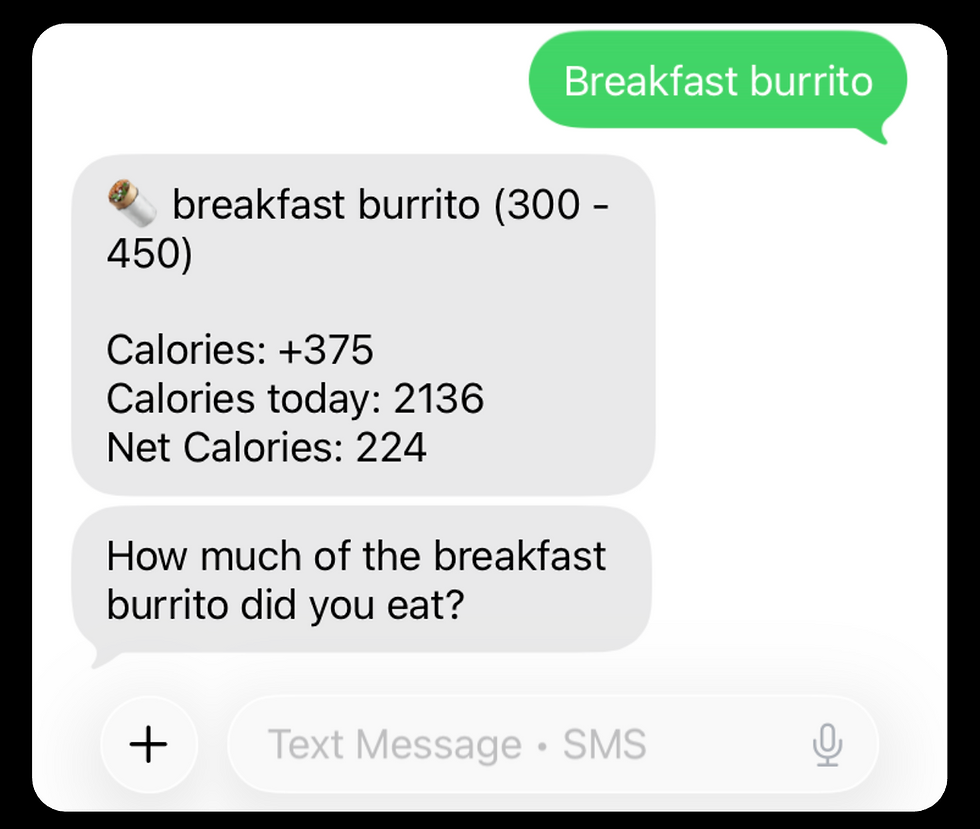
Kalria needs to interpret the food items, estimate the portions, calculate the likely calories and macros, and then reply with a useful summary.
Some messages are simple. Others require more interpretation.
If you send a vague message, Kalria may ask a follow-up question. If you ask for your status, Kalria needs to retrieve your logs and summarize the day. If you send a recipe, Kalria needs to estimate the full recipe and your portion.
That processing involves natural language processing and machine learning systems.
The purpose of that processing is to provide your nutrition log, not to sell your personal information.
How we reduce exposure of personal identifiers
When Kalria uses machine learning services to process a nutrition request, our goal is to avoid sending unnecessary personal identifiers with that request.
In practice, the machine learning system does not need to know your name, email, phone number, or billing details to estimate the nutrition in a meal.
It only needs the relevant content.
For example, it may need to evaluate:
2 eggs and 2 slices of toast
It does not need to know who sent that message.
Kalria separates the nutrition question from direct account identifiers before using hosted machine learning services. That helps reduce the risk that third-party systems can associate a nutrition request with you as an individual.
This is an important design principle for us:
Use the minimum amount of personal information needed to provide the service.
How Kalria stores and protects data
Kalria stores customer and usage data in cloud-based systems using security controls designed to protect sensitive information.
This includes measures such as controlled access, secure infrastructure, and limiting who can access customer data.
Because Kalria is an SMS-based service, messages also move through normal text messaging infrastructure and messaging providers. That is part of how SMS works. We design Kalria with that reality in mind and try to avoid exposing more information than needed.
No system can honestly claim that risk is zero. But we can be clear about the principles:
collect only what is needed
use data only for the service
reduce unnecessary personal identifiers
restrict access
protect stored data
give customers a way to request deletion
How long Kalria keeps your data
If you cancel your subscription, Kalria may retain your account information and logs for up to 12 months.
The reason is simple: some customers may choose to come back.
If you restart the service, you may want access to your previous logs, summaries, weight history, or nutrition trends. Keeping the data for a limited period makes that possible.
After that retention period, Kalria de-identifies your account in our database. In plain English, that means we remove direct personal identifiers like your name and contact details from the usage data and replace the account identity with an internal alias.
For example, imagine a customer named Joe Smith uses Kalria for 6 months and then cancels.
For up to 12 months after cancellation, we retain Joe’s account data in case he decides to restart the service and wants to revisit his prior logs.
After 12 months, Joe Smith’s direct personal identifiers are removed from the retained usage data and replaced with an internal user alias, such as:
KU169812
At that point, the data is no longer directly tied to Joe’s name or contact information in our system.
The goal is to preserve useful product-level information while reducing the link to the individual person.
You can request deletion
Twelve months may feel like a long time. You do not have to wait.
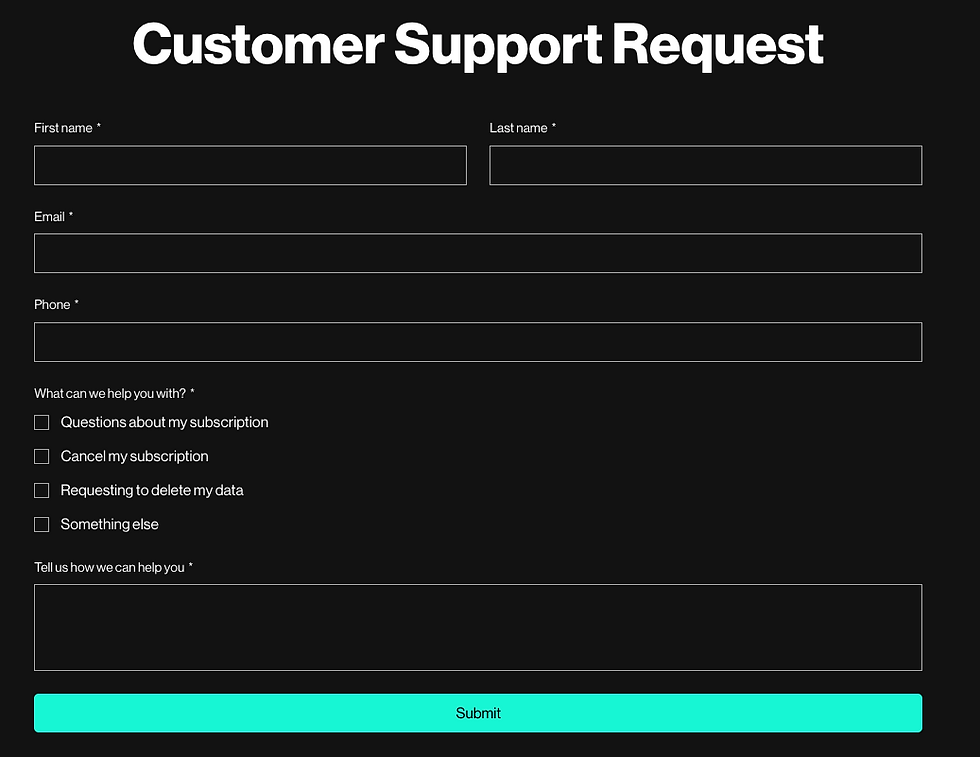
You can request deletion of your personal data by submitting a service ticket through your customer portal.
This probably makes the most sense after you cancel your subscription, but you can make the request at any time.
When we process that request, we remove or de-identify the personal data tied to your account according to our data handling process.
What belongs to the customer
Your personal account information belongs to you. We do not sell your data.
Your food logs, biometrics, messages, weight history, and nutrition summaries are your personal data. You should be able to request access to that data, export it, or request deletion.
That is especially useful if you work with a trainer, dietitian, physician, or coach and want to share your history with them.
Kalria is designed to make your logs useful to you, not trap them inside the platform.
What belongs to Kalria
The Kalria product itself belongs to Kalria.
That includes the way the platform processes messages, estimates nutrition, improves logging accuracy, handles common user requests, and learns from aggregate usage patterns.
This distinction matters.
Your individual nutrition history is personal. But general lessons about how people use the product help us improve the service.
For example, we may learn that users often text incomplete meal descriptions, that certain foods need clarification, or that recipe logging needs better support. Those product-level insights help Kalria become more accurate and easier to use.
The way we protect your privacy is by separating those product-level patterns from your direct personal identity.
The principle is simple
Kalria exists to make nutrition tracking easier.
To do that, we need to handle nutrition and health-related data. But we should only collect what we need, use it for clear purposes, protect it carefully, and give you control over your personal information.
That is the standard we are trying to build around.
Not because data privacy is a checkbox.
Because if you are going to trust Kalria with your nutrition history, you should understand exactly how that data is handled.
Snack responsibly,
Kalria Team

Comments